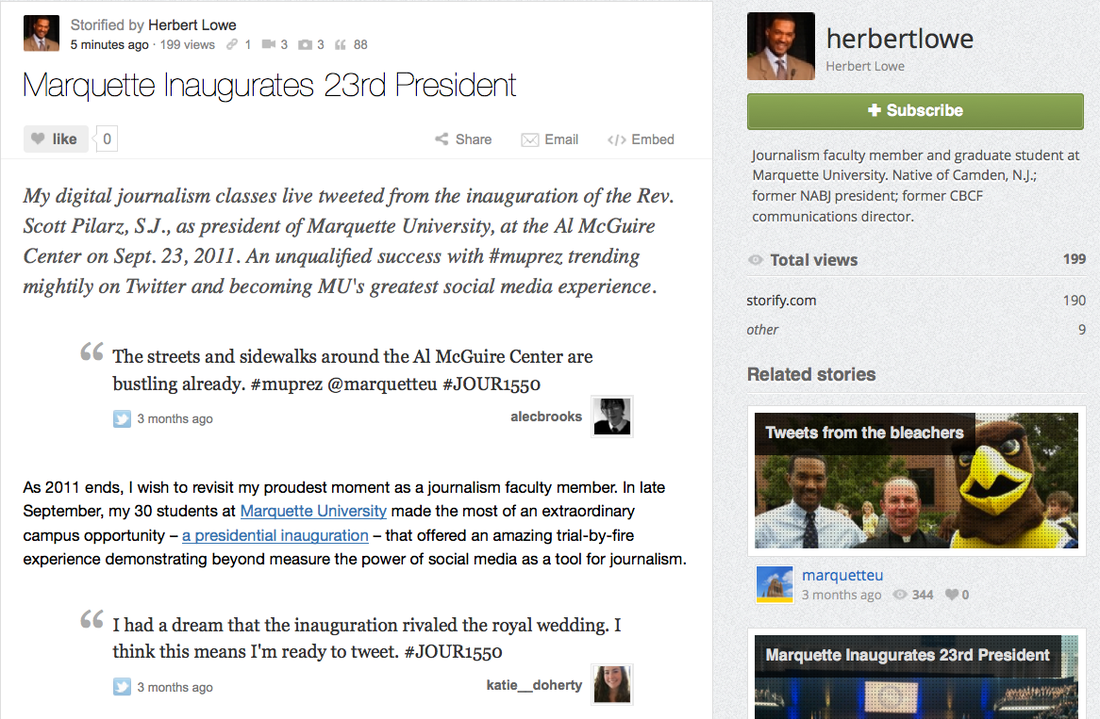
Click the image for a sampling of my students' live tweeting of the presidential inauguration – or view the slideshow below.
As 2011 ends, please allow me to revisit my proudest moment as a journalism faculty member with a new Storify.
In late September, my digital journalism students at Marquette University made the most of an extraordinary campus opportunity – a presidential inauguration – that offered trial-by-fire experience and demonstrated the power of social media as a tool for journalism. Instead of the typical reporting and writing exercise, in which the students would each produce a 500-word story that just I would read – sigh! – they used Twitter to report on the inauguration. Their tweeting allowed countless Marquette alumni and supporters across the world to witness the ceremony live.
Tim Cigelske, a MU communication specialist and the campus social media guru, lauded the students' efforts. "I never thought we would surpass Sweet Sixteen," Cigelske said of the Twitter explosion following the men's basketball team's success last spring. Not only did their inauguration tweeting do so, it also netted the top eight trending topics in Milwaukee that day – "which is huge," he said. (My Storify includes just a sampling from that day.)
The inauguration exercise also readied my students to use Twitter to cover events as reporters through the term. Indeed, live tweeting was only half of the inauguration assignment. Each student also had to create a Storify about the coverage. (The Poynter Institute offers five types of stories that make good Storifys.)
No one knew what to expect beforehand. Those among my students who had tweeted regularly had mostly offered youthful banter. I stressed for class-related tweets using complete sentences, abiding AP style and correct grammar, spelling and punctuation, and no long or uncomplimentary hashtags such as #onmywaytowalgreenstobuylicorice and #icouldrantbutiwont. Both classes practiced with the Princess Diana eulogy before the ceremony. Each student then had to produce at least 12 tweets with their class hashtag and #muprez among the 140 characters.
After live tweeting beyond my wildest dreams, the next generation of professional scribes acted like true journalists – they went searching for food, assessed their own performance and found reasons to complain or blame their editor, that is, professor. That's OK. So gratifying when my students' work matters. Cigelske, formerly of The Associated Press, put it best when he told them during his class visit: "It was like you were all Associated Press reporters. You provided the color and the personality of being right there. You pretty much covered the spectrum – from breaking news to context to archival coverage. This is great training for ... your journalism careers, wherever it takes you."
In late September, my digital journalism students at Marquette University made the most of an extraordinary campus opportunity – a presidential inauguration – that offered trial-by-fire experience and demonstrated the power of social media as a tool for journalism. Instead of the typical reporting and writing exercise, in which the students would each produce a 500-word story that just I would read – sigh! – they used Twitter to report on the inauguration. Their tweeting allowed countless Marquette alumni and supporters across the world to witness the ceremony live.
Tim Cigelske, a MU communication specialist and the campus social media guru, lauded the students' efforts. "I never thought we would surpass Sweet Sixteen," Cigelske said of the Twitter explosion following the men's basketball team's success last spring. Not only did their inauguration tweeting do so, it also netted the top eight trending topics in Milwaukee that day – "which is huge," he said. (My Storify includes just a sampling from that day.)
The inauguration exercise also readied my students to use Twitter to cover events as reporters through the term. Indeed, live tweeting was only half of the inauguration assignment. Each student also had to create a Storify about the coverage. (The Poynter Institute offers five types of stories that make good Storifys.)
No one knew what to expect beforehand. Those among my students who had tweeted regularly had mostly offered youthful banter. I stressed for class-related tweets using complete sentences, abiding AP style and correct grammar, spelling and punctuation, and no long or uncomplimentary hashtags such as #onmywaytowalgreenstobuylicorice and #icouldrantbutiwont. Both classes practiced with the Princess Diana eulogy before the ceremony. Each student then had to produce at least 12 tweets with their class hashtag and #muprez among the 140 characters.
After live tweeting beyond my wildest dreams, the next generation of professional scribes acted like true journalists – they went searching for food, assessed their own performance and found reasons to complain or blame their editor, that is, professor. That's OK. So gratifying when my students' work matters. Cigelske, formerly of The Associated Press, put it best when he told them during his class visit: "It was like you were all Associated Press reporters. You provided the color and the personality of being right there. You pretty much covered the spectrum – from breaking news to context to archival coverage. This is great training for ... your journalism careers, wherever it takes you."
 RSS Feed
