Picture
Metro columnist Eugene Kane visits JOUR 4953 to talk about Trayvon Martin, reporting, writing and his long career in journalism.
I had invited Eugene Kane, a metro columnist at the Milwaukee Journal Sentinel, to visit my JOUR 4953 seminar class last week in hopes of focusing on the Trayvon Martin case that is a national cause celebre. My students knew of the matter already, and Kane had written two related columns – Slinger Case Echoes National Furor Over Trayvon Martin and Hoodie Shouldn't Define Trayvon Martin, or Anyone – so I expected good discussion.

The students had each written blog posts about the Martin case after reading several media-related weblinks I had shared from Richard Prince's Journal-isms, the Poynter Institute and elsewhere before Kane's visit. And he did address the case with the surety one would expect of a metro columnist with 30 years of journalism experience.

"There are certain facts about Trayvon Martin that haven't really changed," Kane said, "even though all these stories are changing: He was unarmed. He was killed. The guy was chasing him. There's a record of a dispatcher who told him, 'You don't have to chase him. We'd rather you not chase him.'" Yet all about the case is so murky. "How can anyone at this point say with absolute certainty that they know what the hell happened?" he asked.

A former president of the Wisconsin Black Media Association, Kane also discussed how the media have progressed – and regressed – concerning newsroom diversity and sensitivity in coverage involving people of color.

However, I couldn't help noticing something: The students seemed more interested in Kane than Martin. For example, after he shared how he got into journalism and his perspective on blogging, a student asked how difficult it is to write three columns a week. "I always feel like I'm on a treadmill," he replied, before stressing the need for maintaining basic reporting: working the phones, developing sources, staying abreast of community concerns, etc.

Other questions focused on how Kane worked to find his voice. "If you read your stuff out loud, you hear your voice," he said, adding later, "If you're really interested in your voice, you have to keep trying." Beyond that, Kane said, he strives to emulate the legendary and hard-hitting columnists – Acel Moore and Chuck Stone, among them – whom he read as a child growing up in Philadelphia and as a student at Temple University.

Kane proudly states that he was among the first columnists to embrace Twitter as a tool for engaging readers. No doubt that he picked up a few more followers – and readers – from JOUR 4953 after his visit.
 
 
It’s rare that all learned while reporting a story gets published or broadcast. Many times, however, unused information is shared in a later story or report. This is such a time. While gathering content for two submissions for Poynter.org last week – one about students missing classes to cover March Madness, the other a related Q-and-A with a top university official – I found the National Sports Journalism Center, based at Indiana University-Purdue University Indianapolis. I contacted Pamela Laucella, an assistant professor and the center’s academic director, about student journalists covering major events. Laucella emailed me back with great input. I couldn’t use it in either story, but what she tells will inform educators and students alike. So, with her permission, I’m sharing it here:

In sports journalism, as you know, it’s vital that students gain experience and exposure through covering events like March Madness, the Indianapolis 500, BCS bowls and the Super Bowl. Industry experience enables students to practice and apply knowledge from the classroom and courses. It also gives them a chance to network and expand contacts. That being said, professors need to ensure students meet course requirements. I try to work around these opportunities. If I know about them in advance (which I usually do), I take dates into consideration when creating the syllabus. With March Madness, we'll discuss coverage, economic impact and other issues during the Final Four. The students who are gone might miss class, but will still need to turn in assignments.  

My graduate course consists of a field project at local Indianapolis sports organizations. Much of the work is done outside the classroom, so I built in field days during the Super Bowl and Final Four weeks. They are working, but do not have to be in the classroom. As far as attendance, I have a policy where students can miss a certain number of classes without a penalty. The graduate students are usually pro-active about letting me know in advance and give reasons and documentation. In cases like the Super Bowl and Final Four, I do give a little leeway. They usually don't miss classes otherwise, so attendance hasn't been an issue. There is no university-wide attendance policy regarding this – in the J-school, instructors create their own attendance policies. The dean receives copies of our syllabi (and I discuss policies with him), however, we have freedom to handle this individually.

As far as ... critical thinking and interpretation, that is important. I stress oral and written communication skills in all of my courses and students write book reviews, critical papers and other projects. I strive for balance. I use academic readings, sports books and stories from multiple platforms. We analyze media coverage and discuss a variety of topics in class. In graduate classes, I especially stress diversity of perspectives, application of ideas and reflective thinking on how to maximize ethics and professionalism in today’s changing and evolving media landscape.

Our program integrates and balances skills courses (print, digital, broadcast) and seminar classes on economic, legal, political and social issues in sport media. We have a mix of instructors – adjuncts from the NCAA, Indianapolis Star, U.S.A. Track & Field and academics and Ph.Ds. I think students stay engaged and enjoy the mix of classes and professors.
 
 
My last blog post focused on my Poynter.org article about students missing classes to cover March Madness. As promised, today we're exploring the topic again, based on another submission, a Q-and-A, for the same website.

The intro begins: "As a professional in residence and a graduate student ... I seek chances to match coursework with reporting and academic pursuits. This week’s assignment in my Humanistic Theories and Methods of Media Studies grad class required me to conduct a semi-structured interview – in which a list of questions must be asked and answered in order – before follow-up quizzing may occur. An hour before class last week, Poynter.org agreed that I should write about journalism educators dealing with students missing classes to cover March Madness. My reporting led me to an ideal person for the course assignment: Marquette Provost John J. Pauly, Ph.D."

After turning in the first story on Friday, I suggested to my Poynter editor that Pauly's view on the matter could interest many people. She agreed and skedded the Q-and-A to run on Monday. Well, there's been quite a bit of feedback. Based on a few tweets and not as many emails, journalism educators and others liked what the provost said. On the other hand, many Marquette students weren't too pleased with all that they read. Indeed, my Digital Journalism II class discussed both of the Poynter submissions for nearly an hour yesterday before I finally stopped them so they could work on their Milwaukee Neighborhood News Service projects.

Look Friday for another blog post about students covering sports journalism. Meanwhile, I'm looking forward to my professor's feedback about my critical assessment – my homework due in class last night – of my interview with the provost. Remains to be seen if and when I'll be sharing that any time soon.
 
 
Pleased to share my article that held the lead spot on the Poynter.org website on Friday afternoon. I love the headline: "What's a journalism professor to do when his students miss class to cover March Madness?"

It begins: "This is a story about a journalism instructor dealing with journalism students missing journalism classes so that they can do journalism. Two undergraduates skipped my classes in Milwaukee — as well as those of their other professors — so they could report on Marquette University men’s basketball games at major postseason tournaments." The nut graph: "So why was I ... questioning my students for seizing real-life experience?"

Enjoyed persuading one of my students to wake up at 6:15 a.m. (PST) so I could interview him by telephone as he sat in his hotel lobby in Phoenix. Wish that I could have included in the article something from everyone who helped inform my perspective and evolution on this matter. Stay tuned for my next two blog posts as there is definitely more to share about student journalists major covering sporting events. (Hints: a Q-and-A with a university official and an offering from another academic about the school and organization where she works.)

By the way, this is my second article published by Poynter.org. The first, which I shared when it ran in August, was "New Pew study confirms digital divide in mobile news interest." Hoping for more articles in the future.
 
 
Picture
Marquette students Tessa Fox, Diana Voigt and Caroline Campbell listen to guest Mike Gousha in their JOUR 4953 seminar.
Having interviewed hundreds of people in his Hall of Fame broadcast journalism career, Mike Gousha laments those cable TV show hosts who aim to prosecute their guests at the expense of civility and a fair exchange of ideas. "At the end of the day, the guest is entitled to his or her opinion," Gousha said yesterday while visiting my journalism seminar class on elections and campaigns. "I'm a firm believer that people make intelligent decisions when they are presented with information. I think people are a lot smarter than we give them credit for."

Gousha spent 25 years as a reporter, anchor and public affairs program host in Milwaukee – indeed, he had the kind of career I wanted upon enrolling as a broadcast journalism major at Marquette University in 1980. Gousha is now a distinguished fellow in law and public policy at the university's law school and hosts "Upfront With Mike Gousha," a Sunday morning program airing statewide. Marquette undergraduates know him primarily as host of "On the Issues With Mike Gousha," the program that brings newsmakers and policy shapers to campus. "We are trying to make a difference in the political discourse in our community," he told my class.

My students clearly enjoyed listening to Gousha talk about the media's role and responsibility in fostering public debate. (It's been a good week for JOUR 4953, as his visit followed that of polling extraordinaire Charles Franklin on Tuesday.) He also discussed the impact of social media on political campaigns, saying candidates love that Facebook lets them better control their message. He also offered some ideas for when the students, as a class assignment, will spend time individually or in pairs covering the Wisconsin primary on April 3.

The class ended with Gousha helping me to urge the students to ask tough questions of those who very much wish they would not. "It's hard," even for someone with his experience and credibility, Gousha said. "You can ask great questions – tough questions – and you don't always get an answer."

Afterward, Gousha shared this with me via email: "Thanks so much for the opportunity to visit with your class. I had a great time and particularly enjoyed the interaction with the students. They were smart, engaged and asked some terrific questions. From where I sat, the future of journalism looked pretty bright, indeed."
 
 
Picture
Visiting law professor Charles Franklin speaks to JOUR 4953 seminar about the opportunities and challenges associated with polling.
While preparing for our journalism seminar on elections and campaigns this spring, James Scotton and I quickly wanted Charles Franklin, a visiting professor of law and public policy at the Marquette Law School, as a guest speaker. But upon telling the class recently that Franklin's visit would happen yesterday, at least one student wasn't feeling it. At least, not initially. See, Franklin is a nationally recognized expert in polling and voter analyses.

"What could be so interesting about polls?" Tessa Fox, a sophomore journalism major, wrote in her weekly blog post. "I thought I got into journalism to stay away from math and numbers. However, after reading some background material about Professor Franklin and the polling process, I realized polling is actually pretty interesting."

Franklin, who told the class that he did his first poll when just a sixth grader, talked about his role in directing a comprehensive, independent survey of voter attitudes in Wisconsin while at the law school. The visiting professor also discussed the opportunities missed now that fewer news organizations can afford to do their own polling.

The students prepped for Franklin's visit by watching, during its last class before spring break, his hourlong "On the Issues With Mike Gousha" presentation on the law school's poll. They also had to review related material for journalists using polls – The New York Times Polling Standards, A Quick Checklist for Using Polls in the Paper and Understanding and Interpreting Polls – and other Web pages focused on the Marquette poll, including Likely Voter Crosstabs and Obama Leads GOP Field as Santorum Surges in Primary.

In her subsequent blog post, Fox said the guest speaker inspired her: "He said he would love to survey people about life in general. More specifically, how they live, how much time they attribute to various activities and the importance level of different material and non-material things. As someone who is very interested in cultural anthropology, I would be very interested to see this poll actually conducted and analyze the results."

Well said. Maybe in the future she won't sigh when I tell the class that someone special is coming to visit.
 
 
Picture
Students from my Digital Journalism I (JOUR 1100) course last semester use audio recorders while interviewing the Rev. John Cusick, director of young adult ministry for the Archdiocese of Chicago, after an Entrepreneurship Week panel discussion at Marquette.
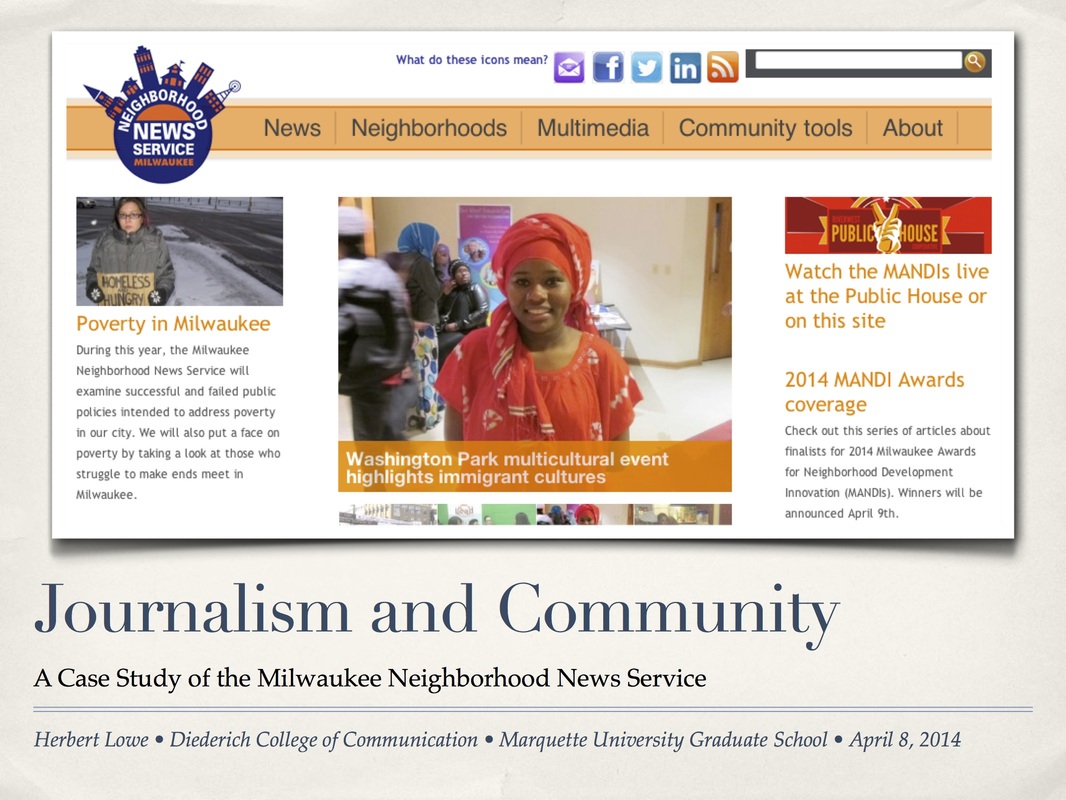
Students in my Digital Journalism II (JOUR 1550) course this week chose their community journalism assignments as part of our collaboration with the Milwaukee Neighborhood News Service. As I shared in an earlier post, the 10 students will work as pairs this semester to produce multimedia packages profiling 2012 MANDI finalists.

We spent most of our time in class yesterday focusing on how to best conduct interviews. Most of the students don't yet have much experience in student media and only one has any in broadcast. So I did a quick Internet search for sure-fire tips on how journalists prepare for interviews and then conduct themselves while in the midst of one. These tips will help journalism students whether they are using audio recorders or depending on pen and paper only.

Sarah Stuteville offers 13 Simple Journalist Techniques for Effective Interviews. Among them, Stuteville writes, are "be a little annoying" – as in don't be afraid to revisit a question or topic that hasn't been completely answered – and "be a little sneaky," or, in other words, remember to continue taking notes even after the interview is over. In Top 10 Tips for Conducting an Exceptional Interview, Pat Flynn reminds us to remember our audience, prepare open-ended questions, strive for a high-quality production and, yes, to have fun. "If you make it seem like a task or a chore, then it will reflect in the interview – and that's not what we want," Flynn writes.

Shreyasi Majumdar provides 10 more tips in The Art of "Question": How to Conduct a Good Journalistic Interview. They range from selecting interviewees with care to setting clear rules for the interview to avoiding stupid questions. "Interviewees do not like being asked questions which insult their intelligence," Majumdar writes, adding that if you think about to ask one, "take a step back, think about the question again, rephrase if necessary, and then present it more intelligently." For broadcast interviews, Angela Grant presents six tips in Audio Interview Advice Also Useful for Video, including don't let you equipment get in the way, asking the speaker to repeat what's just been said if someone coughs or the dog barks, and don't ruin it all with uh-huhs. "Simple nods and smiles are enough to let people know you're listening," Grant writes.

If all these aren't enough, David Sparks shares 30 Tips on How to Interview Like a Journalist that he writes come from his questioning fellow journalists for their best advice. From making the interviewee comfortable, to asking to spell and pronounce their name and title, to asking about feelings, to not trying to fill the void – give the subject time to answer – there's plenty to learn and consider among these tips, whether it's for print, blog, radio, TV and films.

Finally, in 50 Common Interview Q&A, Bhuvana Sundaramoorthy begins with "tell me about yourself" and ends with "do you have any questions for me?" Clearly, this list offers typical job interview questions. But they also can be used or altered by a journalist asking about a person, institution, team, organization, community, etc. For their news service assignments, for example, my students can ask a nonprofit leader, "What motivates you to do your best on the job?" or "Why (did) you want to work for this organization?" or "What is your (organization's) greatest strength?"

Any student that makes smart use of these dozens of interview tips will almost certainly return with a nice story.
 
 
The Diederich College of Communication presented Hall of Fame broadcaster Dick Enberg as this year's Axthelm Memorial Lecture speaker last week at the Alumni Memorial Union on campus. Hundreds of people packed a ballroom to hear Enberg, a 14-time Emmy Award winner, reflect on his experiences with Al McGuire, his longtime broadcast partner and, of course, the beloved coach who led Marquette's men's basketball team to the 1977 NCAA championship. Calling his lecture "Communicating in a World of Noise," he also shared his five "points of power" for succeeding in journalism: pause, perseverance, presentation, humor and kindness.

Enberg also met with students and classes during his latest visit to Marquette – he served as its commencement speaker in 2009 – including a "news conference" after the lecture for my Digital Journalism I (JOUR 1100) class that my Diederich College colleagues James Pokrywczynski and Julie Rosene arranged. Surprising that only one of my 14 students had heard of Enberg when I first said they would use Twitter to cover his lecture. Certainly, I had heard him exclaim his signature "Oh my!" during countless significant sports events of the past generation.

This was the first live-tweeting experience for most of the students. (Of course, I shared what their predecessors had accomplished by live tweeting Marquette's presidential inauguration last fall.) We had practiced in class the week before and some had used the 2012 Grammy Awards and other recent events to try it out. In class after the lecture, they said the #muenberg live tweeting helped them, among other things, focus on their writing; extend their journalism to as far as Puerto Rico; capture moments not typically reported in news articles, and inform and engage MU alumni, students and employees unable to attend. We then discussed curating social media, employing tools and tips used by many professional news agencies and people worldwide.

Indeed, a few students from my other courses this semester (JOUR 1550 and JOUR 4953) also live-tweeted the lecture for their Storify assignments. And the word is spreading across campus. Last night, the Marquette University Student Government speakers commissioner emailed me to ask if I would assign students to live tweet Morgan Spurlock's campus visit on Thursday. The commissioner wrote that "friends studying journalism" had referred her to me. Actually, some in my JOUR 1550 class already plan to live tweet this event; they even had me change the deadline so they could. Still, I love it that students outside of Johnston Hall appreciate what's happening in my classes – and, yes, hope more of them will answer the commissioner's call.

Finally, it must be shared that #muenberg trended in Milwaukee, reaching the same success that #muprez achieved when my classes live tweeted the inauguration. Another sign of progress: Diederich College Dean Lori Bergen encouraged those tweeting to use #muenberg while welcoming them to the Axthelm lecture. With apologies to Enberg, must admit that when the dean did that, I could only say to myself, "Oh my!"
 
 
Picture
Sharif Durhams of the Milwaukee Journal Sentinel speaks to my seminar class about how newsrooms use social media.
"We have to be ready for whenever our viral moment happens," Sharif Durhams said while recalling when then-presidential candidate Herman Cain flubbed a foreign policy question posed by the Milwaukee Journal Sentinel's editorial board in November. Durhams, the Journal Sentinel's social media editor and reporter, said the newspaper quickly posted a short video that attracted more than a million views to that day's campaign coverage.

Durhams spoke yesterday to my JOUR 4953 seminar class on how media report on political campaigns and local, state and national elections. The veteran journalist told the students he has three primary jobs: 1) helping to post breaking news on JSOnline; 2) guiding the newsroom in its use of Twitter, Facebook, Google+, etc., and 3) looking for new ways – think Pinterest! – the paper can use social media to further its storytelling and expand its online audience. "The fun thing about my job is it shifts – because every six months the technology changes," he said.

The North Carolina native also shared how social media helped the Journal Sentinel beat its state and national competition during the huge protests against Wisconsin Gov. Scott Walker's budget cuts last year. "Social media ... taught us that we had to beyond traditional sources to get the news," Durhams said. At the same time, he said, it's important that reporters and editors never allow social media to supersede normal journalism ethics or values.

As much as he enjoys his work, Durhams knows it may not last forever given that social media will soon become second nature for most journalists. He put this way: "It's almost like, 'Do we need a telephone editor? Do we need to teach people how to use the telephone? Well, at least for awhile, we will."

"Great speaker today," James Scotton, who is co-teaching the course with me, said afterward. "Very valuable and the class obviously loved him." Yes, they did. Hoping that Durhams will return this semester to talk more about how the Journal Sentinel is using blogging, Storify and other social media as part of its election coverage.
 
 
I was minding my business at the Journalism Interactive: The Conference on Journalism Education & Digital Media when an interesting tweet appeared among many others on the fast-and-furious live #jiconf stream on Twitter:
Still new at teaching my journalism students how to report, write and edit using social media, #retweetethics certainly interested me, so I quickly tweeted back affirmatively. Honestly, I thought it would lead to learning about such simple matters as using MT to indicate modified tweet. Well, it ended up leading to so much more – including, much to my surprise and pleasure, me recently having, for the first time, an article published in an academic journal.

Ironically, the tweeter – Ginny Whitehouse, an associate professor at Eastern Kentucky University – was sitting two rows behind me at the conference held at the University of Maryland. Whitehouse explained that, as cases and commentaries editor for the Journal of Mass Media Ethics, she needed articles concerning a major lapse in journalism ethics. Her case study stemmed from a fake study claiming to link intelligence and Web browser choice.

Already overwhelmed as a faculty member and graduate school student, I worried about taking on another major assignment, especially since Whitehouse stressed she needed it soon. Ever the student, I initially tried to see if my research for this task could match a similar mandate in my media law course. That didn't work. My first draft submitted to Whitehouse suited the course assignment much better than an ethics journal. But, much to her credit, she would not let me give up and offered great advice on how to proceed. So, too, did Bonnie Brennen, my Diederich College colleague and grad school teacher who is determined to turn me into a critical thinker.

Both Whitehouse and Brennen liked my second draft much better. My article, "An Online Hoax Reminds Journalists to Do Their Duty" – available online and here on my site – is part of a collection of enlightening articles written about the hoax by Whitehouse, Lyn Millner, Wendy Wyatt, David Craig, and Rick Kenney and Kimiko Akita. Must admit it feels good to have an article published in an academic journal, something I didn't see coming so suddenly. When I shared the news with my colleagues at our journalism faculty meeting today, I joked it meant moving further into the dark side. All smiled when someone shot back that I was actually moving closer into the light. Touche´.
 

    Author

    Journalism faculty member and graduate student at Marquette University. Native of Camden, N.J.; former president of the National Association of Black Journalists (NABJ); former communications director for the Congressional Black Caucus Foundation (CBCF).

    Archives

    April 2012
    March 2012
    February 2012
    January 2012
    December 2011
    November 2011
    October 2011
    September 2011
    August 2011
    July 2011
    June 2011
    May 2011
    December 2010
    November 2010
    October 2010
    September 2010

    Categories

    All
    Branding
    Digital Divide
    Digital Storytelling
    Emerging Media
    Journalism
    Journalism Education
    Marquette
    Nabj
    Newsu
    Poynter
    Storify

    RSS Feed