Once again this semester, I have assigned each student in #loweclass a media company website to cover as his or her semester-long beat. They write a blog post each week that evaluates their respective website's successes and misfires, based on either class discussions and the biggest national news story. Their second post, for example, focused on President Obama's second inauguration, while the one due today reviewed Super Bowl coverage. The BBC, The Indianapolis Star, Orlando Sentinel and The Salt Lake Tribune have been added for the first time to the 30 or so websites assigned during previous semesters. Last week, the class and I engaged in a lengthy review of the assignment's opportunities (for example, learning to do media critiques and cover a beat) and challenges (being mindful of not needlessly offending anyone given that blogging is so public and rife with journalistic dangers).A few students have made it clear they wish to cover a site that interests them personally. I want to be sensitive to such concerns. Aspiring journalists must learn early on they won't always get to cover what they want. Indeed, it's how they apply themselves to lesser beats that determines how quickly they advance to more choice assignments. Anyway, what follows is a long-overdue effort to help #loweclass produce better media critiques. Unlike with most other journalism education assignments, there isn't definitive help on the Internet concerning rubrics for evaluating individual student blog posts. This is what I have come up with – I'm still tweaking this rubric, but hoping it helps: CONTENT (3 points): Either excellent (focused and well organized analysis; succinct and confident writing; engaged with the topic; demonstrates appreciation/awareness of course/assignment objectives); or satisfactory (reasonably focused and or organized analysis; moderately engaged with the topic; fewer connections between ideas; writing for the professor, not a greater audience or community); or unacceptable (unfocused or disorganized analysis; limited engagement with the topic; post consists of one or two disconnected paragraphs or sentences; not really interested or interesting). Excellent, of course, means 1 point, while satisfactory and unacceptable are 2 and 1, respectively. MECHANICS (1 point): Avoids errors in grammar, spelling, punctuation or Associated Press style; no form errors or obvious layout concerns (line breaks, errant spacing, widows or orphans); demonstrates quality proofreading. HEADLINE (1 point): Clear and able to stand on its own with no other context; contains likely search words; compels readers to risk a click. Lacks wordiness; avoids puns and oblique references, obscure words or orphans. Mindful of style issues, creativity and variety; written for people, not Google. VISUALS (1 point): Proper use of image(s) or screenshot(s) or embedded media (video, interactive graphic, etc.); effective caption(s) — see headlines; hyperlinked to content elsewhere for additional engagement. HYPERLINKS (1 point): Four minimum. Where do they link to? Relevance? Organization? Appearance? Everything that should be linked is. They add to the story without being too wordy. Show – don't tell. (Each student must do 14 media critiques this term; each post is worth seven points toward a possible total of 98.) That's it. My students' first indications are that they appreciate it. We'll see what happens. What do you think?
I have been dreading this blog post for some time. Early last fall, I made a bet with Diana Dombrowski, a former journalism student now studying communications studies. Here's how this otherwise nice sophomore from Cudahy, Wis. – who seemed to wear her Aaron Rogers jersey to class just to annoy me – explained the wager in an email: So here's the deal that you are going to lose. :-)
If the Packers make it farther into the postseason than the Eagles, you have to take a picture wearing a Packers jersey and write a blog post about why you should be a Packers fan AND why I'm an awesome Packers fan. If the Eagles make it farther into the postseason than the Packers, I will write an apology letter to you for ever doubting the Eagles. I will also take a picture in an Eagles jersey and you can turn this into a blog post.
No matter who wins, we both will be in the picture so that the winner can gloat, of course. If neither team makes it to the postseason, the winner will be determined by who has the better record. We can decide later in the season how we will determine a winner if both teams have the same record. Diana #GoPackGo
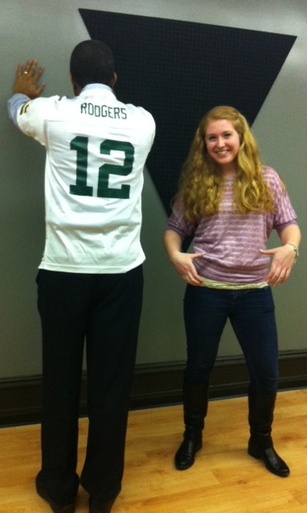
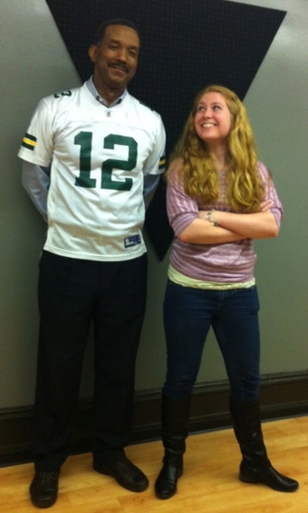
I honestly expected a bounce-back season for the Eagles, given their disappointing 8-8 finish in 2011. Naturally, Dombrowski made herself scarce as my team won three of its first four games, while hers started off 2-2. But the Eagles then lost eight in a row before finishing 4-12. Meanwhile, Green Bay won 9 of its last 12 to end at 11-5. Basically, the Eagles' season was over before Thanksgiving. So, too – to the delight of Dombrowski and every other NFL-loving #loweclass student eager to see me in (sports-related) distress – was the bet. I cannot find the words to explain why Dombrowski is an awesome Packers fan. Let it suffice to say that she is. As for me being a Packers fan? Not going to happen. But as you can see above, true to my word, I donned the jersey. "I hope you're happy; I hope this brings you joy," I said after Gee Ekachai, a Diederich Colleague colleague, took the photographs in Johnston Hall. Dombrowski replied smugly: "It has. You look so defeated. I like to win. I really do."
It seems like forever since I began pursuing the independent study needed to complete my quest for a graduate certificate in digital storytelling from the Diederich College of Communication. Mercifully, today my faculty advisor told me I had done enough to earn those elusive three credits. A recap of "Becoming a Digital Leader and Educator": - My primary goal was to improve my Internet presence so that it better brands me as a journalism educator. In other words, redoing this website. Mission accomplished. I amended the main navigation so that my blog is now the home page, and so my biography, curriculum vitae and teaching emphasis are more accessible.
- #loweclass was born! Thanks to inspiration from the Poynter Institute's News University – and Jennifer Lee Reeves in particular – my journalism classes have a combined home on this site and on Facebook, as well as a brand attracting students and educators elsewhere. #loweclass even trended on Twitter once this fall.
- Speaking of students elsewhere, I enjoyed interacting with three young women who sought my help in better branding themselves as future or new journalists. Meet Erika J. Glover, a graduate of Penn State University, Taylor Shaw of The Triangle Tribune and Kouki Collier of Southern Illinois University-Edwardsville.
- I had two journalism-education articles published on Poynter's website. In July, I wrote a blog about how to make your #twesume count on Twitter. It was so well received that several weeks later the institute allowed me to extend it into a much longer article that was tweeted more than 600 times from its site. Also in July, Poynter published my piece on teaching journalism students to live tweet campus events.
- Yes, live tweeting. That article – and my promoting the concept at major gatherings of journalism educators in July and August – spawned many questions my way about live tweeting and or using Storify. So I created three related blog posts – namely, "Storination: New Tool to the Rescue," "Great Tips on Conference Tweeting" and "Live Tweeting Without a Smartphone" – as well as a new blogroll for all of my live tweeting-related posts.
- I learned some things along the way that have or will be used in the classroom. A blog post, "I Joined Pinterest and Survived," impressed some students while worrying others that I might create a related class assignment (maybe next semester.) Meanwhile, please read "loweclass Live Blogs on Election Day" to see how and why I hurriedly learned to use CoveritLive. Also, some of my students created interactive timelines for class presentations after I showed them my first one, a Dipity.com focusing on my NABJ presidency.
- Two other blogs deserve mention: "Four Words She Can Brand By," about my conversation with Sophia Nelson, a friend and award-winning author; and "Focusing on My Digital Stamp," an endorsement of "Digital Leader: 5 Simple Keys to Success and Influence," the book which inspired this independent study.
I had aspired to do even more as part of this study, including creating a sophisticated story using Final Cut Pro X that involves narration, video and images. (I hope to share just such a story – using the video editing software – by early next month.) That said, here's hoping you will agree that I have earned my three credits.
Click the image to view one of the multimedia packages that my eight students produced for NNS this fall. I reported earlier that my latest Digital Journalism II (JOUR 1550) class would pursue community journalism by focusing on local organizations that serve Milwaukee residents. My 16 students wrote in blog posts that they enjoyed the prospect of having the award-winning Milwaukee Neighborhood News Service (NNS) publish their work, especially after its editor in chief and project director, Sharon McGowan, visited #loweclass #digital. Today, NNS published " Gamble Pays Off for Snyder, Northwest Side CDC." It's by Ethan Niquet and Eva Sotomayor and the eighth and final #loweclass effort for the news service this fall. It's also the third consecutive semester my students have these produced two-minute multimedia packages that include a 650-word story. As always, this class assignment take them to new places – literally and figuratively. For example, after once again having to redo some aspect of their project, Sotomayor posted in the class Facebook group that Niquet said: " I feel like I'm running up Bowser's never-ending staircase and I don't have enough stars to get to the top." Anyway, Casby Bias and Jacob Born had their project, " Martin Drive Neighborhood Events Aim to Bring People Together," published on November 19, well before the rest of their classmates. Among the valuable journalism lessons this pair learned: An assignment that diminishes based on circumstances can be resurrected after a consultation with editors, but then requires expediency so its newsworthiness doesn't expire because of timeliness. Here are the other #loweclass efforts for NNS this term: " Urban Anthropology Celebrates Diversity, Seeks Artists," by Stephanie Graham and Courtney Perry; " Menomonee Valley Partners Works to Lure People to 'Discover' Valley," by Kaitlyn Farmer and Ben Greene; " Dominican Center Combats Lead Poisoning," by Paulo Acuna and Matthew Barbato; " KANDO Landlords Help Neighbors Feel 'More at Peace,'" by Christopher Chavez and Monique Collins; " Silver Spring Teen Programs Inspire Students to Dream of College," by David Tukesbrey and Alexandra Whittaker, and " Northcott a 'Home Away From Home' For Half a Century," by Patrick Leary and Caitlin Miller. Let me say again how much my students and I appreciate the wonderful opportunity that McGowan and NNS present #loweclass. Next semester, I will teach Digital Journalism III (JOUR 2100), in which telling stories with video is taught along with using text, audio, images and social media. Noting here that NNS has published work by 13 of the 18 students enrolled. As we continue to work to make the experience mutually beneficial, me and McGowan agree that we will push the students even harder in terms of their reporting and, especially, writing.
For now, let me share these sentiments McGowan expressed to me via email: "I'm very pleased with the amount of effort that your class put into their projects for NNS, as well as the final products. I enjoyed working with each of the students and appreciate their openness to constructive critique and eagerness to improve their skills."
My seminar students should find this Yahoo News article helpful as they develop and complete their class assignment. Students in my sports journalism seminar this semester have learned about the impact of social media from both sides of press row. Don Walker and Sharif Durham, a veteran sportswriter and social media editor, respectively, talked during separate visits about how beat writers at the Milwaukee Journal Sentinel use Twitter and blogging to cover major league teams and players. Gord Ash, assistant general manager of the Milwaukee Brewers, said during his visit to #loweclass #sports that social media presents challenges for his job that didn't exist 20 years ago. The students will hopefully incorporate what our guest speakers have shared into a significant class assignment drawing near. According to the course syllabus, "each student will write and submit a six-page, double-spaced analysis (approximately 1,500 words) that considers how journalists covering high school, college and professional sports use social media, and what might journalists do to improve their use of social media to cover all such sports." They might also draw upon " Sports Journalists' Use of Social Media and Its Effects on Professionalism," an article in the Journal of Sports Media (fall 2011, Vol. 6, No. 2). The research conducted by Sada Reed, a graduate student in the University of Minnesota's School of Journalism and Mass Communication, begins with this abstract: "The rise of social media gives sportswriters new avenues for gathering information. This usage raises ethical issues that challenge an already technologically morphing industry. In this pilot study, Minnesota-based sports journalists were interviewed about their use of social media, the effects Facebook and Twitter have on their news gathering practices, the ethics of pulling direct quotes from social mediums, and how these mediums have blurred traditional lines between sports writers’ professional and personal relationships."
" Tweeting With the Enemy? The Impacts of New Social Media on Sports Journalism and the Education of Sports Journalism Students" is another article that might prove useful. Published by Journalism Education (April 2012, Vol. 1, No. 1), the work by three scholars from Sunderland University addresses 1) how are sports journalists adapting to and using Twitter in their work, 2) what do these journalists perceive to be the major benefits and drawbacks for their profession so far, and 3) what lessons does this have for the training of future sports journalists? I also urge the students to read about the role of Twitter in covering sports scandals, how sports journalists use it to develop and promote their stories and whether it can detect bias among them. Meanwhile, Ronnie Ramos and the National Sports Journalism Center offer " Social Media Still Challenges Journalists, Understanding on the Rise" and Four Ways Social Media has Deteriorated Traditional Journalism." And from Yahoo News there's " NBC Sports Journalists Now Using Social Media and Web Video Reporting to Bring NFL Fans Closer to the Game." Here's hoping that Walker, Durham, Ash and I have given the class enough to get started on their assignment.
Not long before Tuesday, my journalism seminar on campaigns and elections discussed what we would do in class on Election Day. We meet from noon to 1:15 p.m. on Tuesdays and Thursdays. I offered to bring pizza and suggested monitoring mid-day elections coverage on major media websites. Junior journalism major Melanie Lawder's body language indicated she wasn't feeling that idea one bit. When I inquired further, Lawder said, in so many words, that the class should do journalism on Election Day. Her classmates signaled that they agreed. Naturally, I sought to oblige. The students and I quickly considered how they could best interact with voters at polling places at or near Marquette University: Live tweeting. Exit polling. Multimedia reporting. Live blogging. Two factors led us toward the last option. First, Alec Brooks, another junior journalism major, explained how The Marquette Tribune – he is the student newspaper's copy chief – had begun to experiment with live blogging. Second, I know that many journalism educators and media companies use the technique in their classes and newsrooms. Deciding what to do was easy. Executing the first #loweclass live-blogging experience would be a challenge. (Making things even more interesting: the 10 students in my journalism seminar on sports journalism, which also meets for 75 minutes each Tuesday, would participate, too.) I figured if my students could live tweet a university president's inauguration with only a day's training, learning how to live blog on Election Day was doable. As luck would have it, I attended the national college media convention last week in Chicago – where Jill Van Wyke, an assistant journalism professor at Drake University, expertly taught an audience how to use CoveritLive, a leading live event publishing platform used by mainstream media, educators, bloggers and major brands worldwide. I alerted the 15 students that they would use CoveritLive via Facebook on November 2. Two days later, we used Facebook again to let them pick which polling site to be at. The next day, Monday, less than 24 hours before the polls opened, I sent a long email that outlined the plan – they were all to live blog for at least 75 minutes from their respective site – offered instructions for the CoveritLive smartphone app and provided tips on the differences between live tweeting and live blogging. I also advised that a related blog post from Steve Buttry could be helpful. Also, they were told to use the hashtag #jelection, in addition to #loweclass, so that their work would be seen and appreciated alongside the many student journalists who were covering Election Day nationwide. As expected, given the nail-biting presidential election and U.S. senate campaign in Wisconsin, voter turnout was high. Two students – Ashley De La Torre and Ryan Ellerbusch of #loweclass #sports – started the live blogging when they reported at 6 a.m. to Alumni Memorial Union on campus. That polling place turned out to be especially busy throughout the day, and De La Torre and Ellerbusch proved crucial in helping us all figure out CoveritLive. By and large, the students seemed to appreciate doing journalism on Election Day. As for live blogging and CoveritLive, the reviews were mixed, with some saying, for example, they liked not being restricted to 140 characters (as with Twitter) and that the experience allowed them to focus more on reporting. Others, however, did not think it was an appropriate assignment for a sports class or know what to do when they had finished live blogging. This was all very good feedback for the next #loweclass live-blogging experience. From my perspective, I enjoyed how live blogging enabled me to interact with my students as they interacted with real people. More importantly, the experience showed where some of the journalism majors were in terms of their reporting skills. The biggest thing is that several of them were hesitant or seemingly afraid to talk with people they didn't know – an essential part of Election Day reporting for journalists. As veteran live tweeters, they are comfortable sharing short quotes from speakers or offering observations about what they see or hear. Live blogging can help them better realize the value of reporting and telling stories in a breaking news format. It was all worthwhile, though, when the students learned how to get voters to answer their questions. As senior journalism major Michael LoCicero put it in his blog post, "Many people are turned off immediately if you ask for something private like their voting preference, but many people were happy to talk about having the chance to express their views." It's always great when students learn something – even when they don't always want to.
Meg Kissinger's "Imminent Danger" package inspired #loweclass via the Web as much as she did in the classroom. It's always great when my students really enjoy a guest speaker's presentation. ( Sharif Durhams, Mike Gousha, Eugene Kane, Mira Lowe and Sharon McGowan are among those who readily come to mind.) Well, rarely have I seen young people as inspired and enthralled as when reporter Meg Kissinger visited #loweclass to talk about her award-winning journalism career and her coverage of mental health for the Milwaukee Journal Sentinel. Kissinger is in residence this academic year at the Diederich College of Communication and collaborating with Marquette University students as she pursues a series of investigative and explanatory stories focusing on mental health. My Digital Journalism II students had been assigned to review Kissinger's impressive " Imminent Danger" package for the Journal Sentinel – as well as these two stories: " Can Adult Siblings Connect When Mental Illness is Part of Mix" and " At Death's Door, But Living Life to the Fullest" – before her class visit on October 24. Nearly all of the 16 students wrote their assigned weekly blog posts about what Kissinger revealed about her life, family and career while sitting at the conference table with them and chatting for more than an hour. " Let me just say this: I love Meg Kissinger," began the post by Monique Collins, one of three students who shared how mental health or a serious medical condition has touched their own families. " Meg Kissinger could have spoken to our class for another two hours and I don't think anyone in the room would have complained," Alexandra Whittaker wrote. " What really struck me about Kissinger was her positive energy," Stephanie Graham offered. David Tukesbrey wrote in his post: " She's somebody that all journalists can aspire to be. When she sits down and talks to you, she looks you in the eye. Although she's a great journalist, more importantly she's a great person." Students also described Kissinger as v ibrant, charming, witty, personable, funny, knowledgable, smart, hardworking and passionate.
Caitlin Miller echoed everyone in the class when she wrote that " I am really excited" about the course's final project – in which Kissinger and I aim to dispatch them as teams of two into Milwaukee County to interview people who impact or are impacted by mental health: advocate, family member, judge/court commissioner, nurse, patient, police officer, psychiatrist and social worker. The projects will be similar to those the class are producing for the Milwaukee Neighborhood News Service this fall. If all goes well, the Journal Sentinel will publish the mental health projects.
I often say in #loweclass and elsewhere that there are two kinds of college students: those who want a grade and those who want a career. I'm so pleased that three of my students recently used key elements of their coursework – blogging and personal websites – to showcase their storytelling gifts after experiencing monumental circumstances. It's important to note that in each case the student did so without the work being assigned or garnering extra credit. Unable to get back to Milwaukee from New York, where he had covered the Big East cross-country championship for the Marquette Tribune, sophomore Christopher Chavez posted " Stranded in New York: The Hurricane Sandy Story" on the website he created for my Digital Journalism II course this semester. "Yesterday afternoon," Chavez wrote, referring to Monday, "the streets in my neighborhood of Jackson Heights were dark and the wind was picking up. I did not step outside my home at all the entire day. I stayed in my room and had my laptop and phone plugged in at all times, so that when I lost power I would be ready to tackle the storm and stay connected." On October 22, his classmate, Caitlin Miller, also a sophomore, posted " How My Typical Day at Work Changed in an Instant." Miller described how she and her co-workers in The Children's Place in the Brookfield Square Mall coped as authorities responded to the tragic shooting at the Azana Salon and Spa the day before. "I would have never imagined – and still cannot believe – (that) incidents like this could happen in the small suburban city I grew up in," she wrote. "It is still hard for me to grasp the fact that I was outside, right across the street, with the spa in plain view, when Radcliffe Haughton opened fire inside. Nothing prepares you for a situation like that." On a happier note, Tess Quinlan, a junior who was in #loweclass #digital last semester, on October 14 posted " My Summer Turned Golden in London at 2012 Olympics." In a blog post that cannot help but inspire other aspiring journalists, Quinlan recalled the "incredible production experience" she gained while interning for NBC in the International Broadcast Centre during the Summer Games in England. "Whenever I talk about something that I accomplished while over there, I realize that it was not just my accomplishment, but one of a group of dedicated people that gave everything they had every day," she wrote. "Everyone I met at NBC genuinely cared about each other, but (also) wanted to create great television, a balance that can be very difficult to find." Please take the time to read all three blog posts. Chavez, Miller and Quinlan won't get a grade for their efforts. But it's easy to see that they are serious about earning something much more lasting: a career. Warms my heart.
Click the image to see the essays by me and other MU faculty focusing on key issues of this presidential election cycle. Very pleased to share that the latest edition of Marquette Magazine is out – and that I (finally) have a byline in it. Yes, there may be some bias, but I believe that my university has one of the best alumni magazines around. I imagine all of the 130,000 MU alumni and friends worldwide who get each quarterly issue enjoy it just as much. In an email suggesting a focus on the election climate and process, Editor Joni Moths Mueller wrote: "Given the subject matter and the fact that our alums belong to both major parties, but also second-tier parties, the issue would not take a left or right slant but be an informative and thought-provoking issue that shares the expertise of some faculty. ... I saw in your blog that you taught a class on social media as it affects campaigning, which got me wondering whether you would be comfortable writing an essay as one of our expert authors – in your case speaking to the impact of social media and the 24-hour news cycle on both candidates and voters?" Of course, I readily agreed to contribute. Please read my essay, " Campaigning in 140 Characters," which spotlights efforts by The Washington Post, Pew Research Center, NM Incite and others to promote greater interaction between voters and candidates via social media. (I also cited and particularly recommend " Ten Ways Social Media Can Improve Campaign Engagement and Reinvigorate American Democracy," by Darrell West of the Brookings Institution in Washington; and " 25 Ways to Use Facebook, Twitter and Storify to Improve Political Coverage," by Mallary Tenore of the Poynter Institute in Florida.) You will find the related faculty essays by Charles Franklin (who visited my elections class last fall), Christopher Murray and Amber Wichowski on the same webpage as mine. Again, this is my first writing contribution for Marquette Magazine. I must say that it is as gratifying as being featured in one of the publication's alumni profiles in the winter 2006. Reminds me of when the magazine featured a Twitter posting by one of my journalism students, Ceili Emma Seim, in its winter 2010 edition: "I'm having my class assignment critiqued by Pulitzer Prize-winning alumna Jacqui Banaszynski. @Marquette U is seriously amazing."
|