The Poynter Institute's e-learning project, News University, was among the first places I turned to before starting my first semester as a journalism educator in January 2010. (I found great syllabi to pull ideas from at NewsU's syllabus exchange and recommend it to all beginning journalism educators.) Recently, I called Vicki Krueger at NewsU to learn more about how my two digital journalism courses could best employ its offerings this semester. That conversation and subsequent ones with Howard Finberg at NewsU and Diederich College Dean Lori Bergen and journalism department chairwoman Karen Slattery have in a two-week span led to something phenomenal.
Here's what I wrote in my syllabi for my Digital Journalism I and Digital Journalism II courses: "As part of an experimental effort between the Diederich College of Communication and the Poynter Institute’s News University, students in this course will have the chance to earn, along with a grade, a certificate from the nation’s premiere journalism think tank. Poynter says its NewsU certificates help the instructor supplement other teaching material and evaluate each student’s understanding of essential journalism skills and best practices. The custom certificate created by the college and Poynter consists of seven online modules. To earn a certificate, each student must pass the assessments for each of those modules. Poynter describes the assessments as rigorous and designed to test comprehension and not memorization. Earning this certificate will be of immediate value to each student, as it will look great on a LinkedIn profile, especially when time to apply for internships and or that first job after graduation."
My students know a good thing when they see it and are excited about the certificate opportunity. In each class, the initiative is required and accounts for 15 percent of the final grade. While each course will have seven modules formally accessed, I'll also use several other NewsU modules as interactive learning guides during class time. Essentially, the modules serve as textbooks; I lead the class discussion same as with any other online resource.
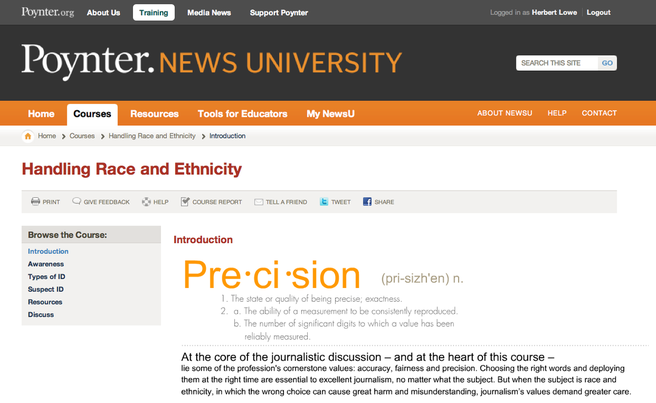
On Tuesday, both classes engaged in our first module, "Handling Race and Ethnicity." We looked at how we view these critical matters, how and when they should appear in news stories, and describing suspect identification and the way people look. I found it interesting that so many of my students consider themselves German; I wouldn't have suspected the number would be so high just by looking at them – that's part of the lesson, for whomever engages the module, no matter their level of journalism or life experience. What did not surprise me is how seriously my students took to what the module offered, as they definitely seem to care about diversity and portraying people accurately.
I hope to write about this certificate experience in this blog through the semester. Another lesson: don't have the students look at a module on their classroom computers while I'm doing the same from the projector. At least a couple of them will move ahead of the lesson and know the correct answer before I ask for it. Students!
Here's what I wrote in my syllabi for my Digital Journalism I and Digital Journalism II courses: "As part of an experimental effort between the Diederich College of Communication and the Poynter Institute’s News University, students in this course will have the chance to earn, along with a grade, a certificate from the nation’s premiere journalism think tank. Poynter says its NewsU certificates help the instructor supplement other teaching material and evaluate each student’s understanding of essential journalism skills and best practices. The custom certificate created by the college and Poynter consists of seven online modules. To earn a certificate, each student must pass the assessments for each of those modules. Poynter describes the assessments as rigorous and designed to test comprehension and not memorization. Earning this certificate will be of immediate value to each student, as it will look great on a LinkedIn profile, especially when time to apply for internships and or that first job after graduation."
My students know a good thing when they see it and are excited about the certificate opportunity. In each class, the initiative is required and accounts for 15 percent of the final grade. While each course will have seven modules formally accessed, I'll also use several other NewsU modules as interactive learning guides during class time. Essentially, the modules serve as textbooks; I lead the class discussion same as with any other online resource.
On Tuesday, both classes engaged in our first module, "Handling Race and Ethnicity." We looked at how we view these critical matters, how and when they should appear in news stories, and describing suspect identification and the way people look. I found it interesting that so many of my students consider themselves German; I wouldn't have suspected the number would be so high just by looking at them – that's part of the lesson, for whomever engages the module, no matter their level of journalism or life experience. What did not surprise me is how seriously my students took to what the module offered, as they definitely seem to care about diversity and portraying people accurately.
I hope to write about this certificate experience in this blog through the semester. Another lesson: don't have the students look at a module on their classroom computers while I'm doing the same from the projector. At least a couple of them will move ahead of the lesson and know the correct answer before I ask for it. Students!
 RSS Feed
