I love divine intervention? The latest for me came in a wonderful email early Friday from John Watson, J.D., Ph.D., an associate professor at the American University School of Communication, and someone recalling when we were members of the fledging Garden State Association of Black Journalists in the late 1980s. "I just finished reading your commentary on the AptiQuant hoax in the Journal of Mass Media Ethics," Watson wrote. "Well done. It's a rare experience to discover someone I met in the professional world of journalism writing in the peer-reviewed scholarly journals. As someone who made the transition a bit earlier than you and who still sometimes finds it bewildering, you seem to be handling it well." Specializing in communication law and journalism ethics, Watson also let me know "I am available if you need any help navigating this new world." I quickly thanked him for his encouragement and asked for immediate help. I needed a three-page curriculum vitae by today! Could he email a copy of his CV so I could perhaps model it during the weekend? He shared his full academic-size version and one only four pages long. Just what I needed! The notion of a CV has been, well, bewildering. For most of my career, the focus has been on one-page resumes. On the other hand, a complete CV seems to need basically everything you have ever done in your life. Last June, I created what I thought was a thorough three-page CV, only to have a friend and mentor tell me I had crammed six pages worth of information into it – with little chance of any of it being read by swamped evaluators. Another challenge is producing a suitable document when my experience is much more professional than academic. A few helpful guides exist online, including " Writing the Curriculum Vitae," " How to Prepare a Killer CV" and " The Alternative to Your Journalism CV." This time, however, I gratefully used Watson's example – and one shared by my fellow Marquette alum Andrew Mendelson, Ph.D., the journalism department chairman at Temple University – to fashion a legitimate three-page summary of my work and service so far in academia. My hope is to have a more extensive CV by summer's end. Your suggestions and prayers are much appreciated.
I have been blessed to celebrate many birthdays in my life, but rarely had one seemed so public as mine did yesterday. Facebook revealed to my students what I would not have otherwise, and they showed me plenty of love with "Happy Birthday" wishes from midnight on via that social media site and, of course, Twitter. The love extended throughout the day in the Diederich College of Communication hallways and one of my classes had cookies waiting when we met in the afternoon. I hesitate to mention the "cat greetings" in the class Facebook groups. Actually, I had been feeling the love all week. On Monday, a student posted in the Digital Journalism II group that #JOUR1100 and #JOUR1550 – "students tweeting for journalism courses" – were among the "100 @MarquetteU Twitter hashtags to watch for," according to the postmarq blog post, " A Field Guide to the Hashtags of @MarquetteU." The blog belongs to Mykl Novak, a Marquette employee and alumnus. As reported on my blog before, my students also can take credit for Novak citing the #muprez tag, for all those many tweets relating to the university's president, the Rev. Scott Pilarz, S.J., or his inauguration in September. Then, more love two days ago, this time from the student media in Johnston Hall. Guess who made The Marquette Journal's list of " Top 5 Marquette Tweeters"? Alexandra Whittaker's article in the magazine's "College Life" section posted online said that "Lowe uses Twitter to interact with students and to post updates on his blog, and this makes his Twitter feed lively and engaging. It is certainly one to follow." It's definitely humbling to be among "Marquette's most interesting Twitter birds" and I'm especially excited to be cited above @ShitMUDoesntSay. Alas, not all went as I had hoped on my birthday, given that Marquette's men's basketball team lost its quarterfinal matchup against Louisville in the Big East Tournament. But my wife, Mira, cooked me a lobster dinner. All is well.
Students from my Digital Journalism I (JOUR 1100) course last semester use audio recorders while interviewing the Rev. John Cusick, director of young adult ministry for the Archdiocese of Chicago, after an Entrepreneurship Week panel discussion at Marquette. Students in my Digital Journalism II (JOUR 1550) course this week chose their community journalism assignments as part of our collaboration with the Milwaukee Neighborhood News Service. As I shared in an earlier post, the 10 students will work as pairs this semester to produce multimedia packages profiling 2012 MANDI finalists. We spent most of our time in class yesterday focusing on how to best conduct interviews. Most of the students don't yet have much experience in student media and only one has any in broadcast. So I did a quick Internet search for sure-fire tips on how journalists prepare for interviews and then conduct themselves while in the midst of one. These tips will help journalism students whether they are using audio recorders or depending on pen and paper only. Sarah Stuteville offers 13 Simple Journalist Techniques for Effective Interviews. Among them, Stuteville writes, are "be a little annoying" – as in don't be afraid to revisit a question or topic that hasn't been completely answered – and "be a little sneaky," or, in other words, remember to continue taking notes even after the interview is over. In Top 10 Tips for Conducting an Exceptional Interview, Pat Flynn reminds us to remember our audience, prepare open-ended questions, strive for a high-quality production and, yes, to have fun. "If you make it seem like a task or a chore, then it will reflect in the interview – and that's not what we want," Flynn writes. Shreyasi Majumdar provides 10 more tips in The Art of "Question": How to Conduct a Good Journalistic Interview. They range from selecting interviewees with care to setting clear rules for the interview to avoiding stupid questions. "Interviewees do not like being asked questions which insult their intelligence," Majumdar writes, adding that if you think about to ask one, "take a step back, think about the question again, rephrase if necessary, and then present it more intelligently." For broadcast interviews, Angela Grant presents six tips in Audio Interview Advice Also Useful for Video, including don't let you equipment get in the way, asking the speaker to repeat what's just been said if someone coughs or the dog barks, and don't ruin it all with uh-huhs. "Simple nods and smiles are enough to let people know you're listening," Grant writes. If all these aren't enough, David Sparks shares 30 Tips on How to Interview Like a Journalist that he writes come from his questioning fellow journalists for their best advice. From making the interviewee comfortable, to asking to spell and pronounce their name and title, to asking about feelings, to not trying to fill the void – give the subject time to answer – there's plenty to learn and consider among these tips, whether it's for print, blog, radio, TV and films. Finally, in 50 Common Interview Q&A, Bhuvana Sundaramoorthy begins with "tell me about yourself" and ends with "do you have any questions for me?" Clearly, this list offers typical job interview questions. But they also can be used or altered by a journalist asking about a person, institution, team, organization, community, etc. For their news service assignments, for example, my students can ask a nonprofit leader, "What motivates you to do your best on the job?" or "Why (did) you want to work for this organization?" or "What is your (organization's) greatest strength?" Any student that makes smart use of these dozens of interview tips will almost certainly return with a nice story.
The Diederich College of Communication presented Hall of Fame broadcaster Dick Enberg as this year's Axthelm Memorial Lecture speaker last week at the Alumni Memorial Union on campus. Hundreds of people packed a ballroom to hear Enberg, a 14-time Emmy Award winner, reflect on his experiences with Al McGuire, his longtime broadcast partner and, of course, the beloved coach who led Marquette's men's basketball team to the 1977 NCAA championship. Calling his lecture "Communicating in a World of Noise," he also shared his five "points of power" for succeeding in journalism: pause, perseverance, presentation, humor and kindness. Enberg also met with students and classes during his latest visit to Marquette – he served as its commencement speaker in 2009 – including a "news conference" after the lecture for my Digital Journalism I (JOUR 1100) class that my Diederich College colleagues James Pokrywczynski and Julie Rosene arranged. Surprising that only one of my 14 students had heard of Enberg when I first said they would use Twitter to cover his lecture. Certainly, I had heard him exclaim his signature "Oh my!" during countless significant sports events of the past generation. This was the first live-tweeting experience for most of the students. (Of course, I shared what their predecessors had accomplished by live tweeting Marquette's presidential inauguration last fall.) We had practiced in class the week before and some had used the 2012 Grammy Awards and other recent events to try it out. In class after the lecture, they said the #muenberg live tweeting helped them, among other things, focus on their writing; extend their journalism to as far as Puerto Rico; capture moments not typically reported in news articles, and inform and engage MU alumni, students and employees unable to attend. We then discussed curating social media, employing tools and tips used by many professional news agencies and people worldwide. Indeed, a few students from my other courses this semester (JOUR 1550 and JOUR 4953) also live-tweeted the lecture for their Storify assignments. And the word is spreading across campus. Last night, the Marquette University Student Government speakers commissioner emailed me to ask if I would assign students to live tweet Morgan Spurlock's campus visit on Thursday. The commissioner wrote that "friends studying journalism" had referred her to me. Actually, some in my JOUR 1550 class already plan to live tweet this event; they even had me change the deadline so they could. Still, I love it that students outside of Johnston Hall appreciate what's happening in my classes – and, yes, hope more of them will answer the commissioner's call. Finally, it must be shared that #muenberg trended in Milwaukee, reaching the same success that #muprez achieved when my classes live tweeted the inauguration. Another sign of progress: Diederich College Dean Lori Bergen encouraged those tweeting to use #muenberg while welcoming them to the Axthelm lecture. With apologies to Enberg, must admit that when the dean did that, I could only say to myself, "Oh my!"
Sharif Durhams of the Milwaukee Journal Sentinel speaks to my seminar class about how newsrooms use social media. "We have to be ready for whenever our viral moment happens," Sharif Durhams said while recalling when then-presidential candidate Herman Cain flubbed a foreign policy question posed by the Milwaukee Journal Sentinel's editorial board in November. Durhams, the Journal Sentinel's social media editor and reporter, said the newspaper quickly posted a short video that attracted more than a million views to that day's campaign coverage. Durhams spoke yesterday to my JOUR 4953 seminar class on how media report on political campaigns and local, state and national elections. The veteran journalist told the students he has three primary jobs: 1) helping to post breaking news on JSOnline; 2) guiding the newsroom in its use of Twitter, Facebook, Google+, etc., and 3) looking for new ways – think Pinterest! – the paper can use social media to further its storytelling and expand its online audience. "The fun thing about my job is it shifts – because every six months the technology changes," he said. The North Carolina native also shared how social media helped the Journal Sentinel beat its state and national competition during the huge protests against Wisconsin Gov. Scott Walker's budget cuts last year. "Social media ... taught us that we had to beyond traditional sources to get the news," Durhams said. At the same time, he said, it's important that reporters and editors never allow social media to supersede normal journalism ethics or values. As much as he enjoys his work, Durhams knows it may not last forever given that social media will soon become second nature for most journalists. He put this way: "It's almost like, 'Do we need a telephone editor? Do we need to teach people how to use the telephone? Well, at least for awhile, we will." "Great speaker today," James Scotton, who is co-teaching the course with me, said afterward. "Very valuable and the class obviously loved him." Yes, they did. Hoping that Durhams will return this semester to talk more about how the Journal Sentinel is using blogging, Storify and other social media as part of its election coverage.
I had the pleasure of being the guest speaker at a Social Media @Marquette event earlier this month. Tim Cigelske, a communications specialist with the Marquette University Office of Marketing and Communication, asked me to focus on using social media in the classroom – and using it to engage with students away from class. It was a GROW With Marquette event, so my audience included mostly staff and administrators of various non-academic units who were, hopefully, interested in using social media to extend their personal and organizational branding. So that those present could see someone curate what just happened, I asked Marissa Evans, a junior journalism major in the Diederich College of Communication and a self-described CLT (Chronic Live Tweeter), to capture the hourlong session using Twitter. Her efforts made it possible for me to share some of the highlights of my presentation, " Digital Footprints: Using Social Media in the Classroom and in the Office," using Storify. I love using Storify to preserve on the Web what happens at an event, whether large or small, for long after it is over. That's right, program coordinators, social media isn't just for increasing attendance and promoting results. It's also for showcasing mission and identity to current and prospective students as well as to alumni. Anyway, I enjoyed showing how my students use Facebook, LinkedIn, Twitter, Storify, Delicious, etc., for their class assignments and journalism pursuits, and how they and I use Facebook and Twitter to interact outside class. Here's hoping that my colleagues across campus will be inspired to maximize social media. As I said in my presentation, I came to Twitter kicking and screaming – but once I started using it for fun, using it for work was so much easier.
I was minding my business at the Journalism Interactive: The Conference on Journalism Education & Digital Media when an interesting tweet appeared among many others on the fast-and-furious live #jiconf stream on Twitter: Still new at teaching my journalism students how to report, write and edit using social media, #retweetethics certainly interested me, so I quickly tweeted back affirmatively. Honestly, I thought it would lead to learning about such simple matters as using MT to indicate modified tweet. Well, it ended up leading to so much more – including, much to my surprise and pleasure, me recently having, for the first time, an article published in an academic journal. Ironically, the tweeter – Ginny Whitehouse, an associate professor at Eastern Kentucky University – was sitting two rows behind me at the conference held at the University of Maryland. Whitehouse explained that, as cases and commentaries editor for the Journal of Mass Media Ethics, she needed articles concerning a major lapse in journalism ethics. Her case study stemmed from a fake study claiming to link intelligence and Web browser choice. Already overwhelmed as a faculty member and graduate school student, I worried about taking on another major assignment, especially since Whitehouse stressed she needed it soon. Ever the student, I initially tried to see if my research for this task could match a similar mandate in my media law course. That didn't work. My first draft submitted to Whitehouse suited the course assignment much better than an ethics journal. But, much to her credit, she would not let me give up and offered great advice on how to proceed. So, too, did Bonnie Brennen, my Diederich College colleague and grad school teacher who is determined to turn me into a critical thinker. Both Whitehouse and Brennen liked my second draft much better. My article, "An Online Hoax Reminds Journalists to Do Their Duty" – available online and here on my site – is part of a collection of enlightening articles written about the hoax by Whitehouse, Lyn Millner, Wendy Wyatt, David Craig, and Rick Kenney and Kimiko Akita. Must admit it feels good to have an article published in an academic journal, something I didn't see coming so suddenly. When I shared the news with my colleagues at our journalism faculty meeting today, I joked it meant moving further into the dark side. All smiled when someone shot back that I was actually moving closer into the light. Touche´.
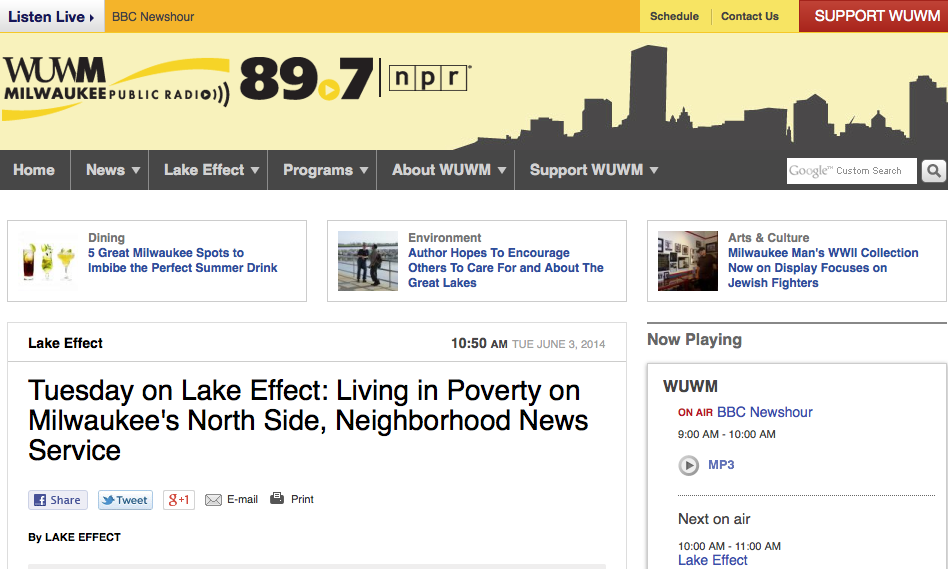
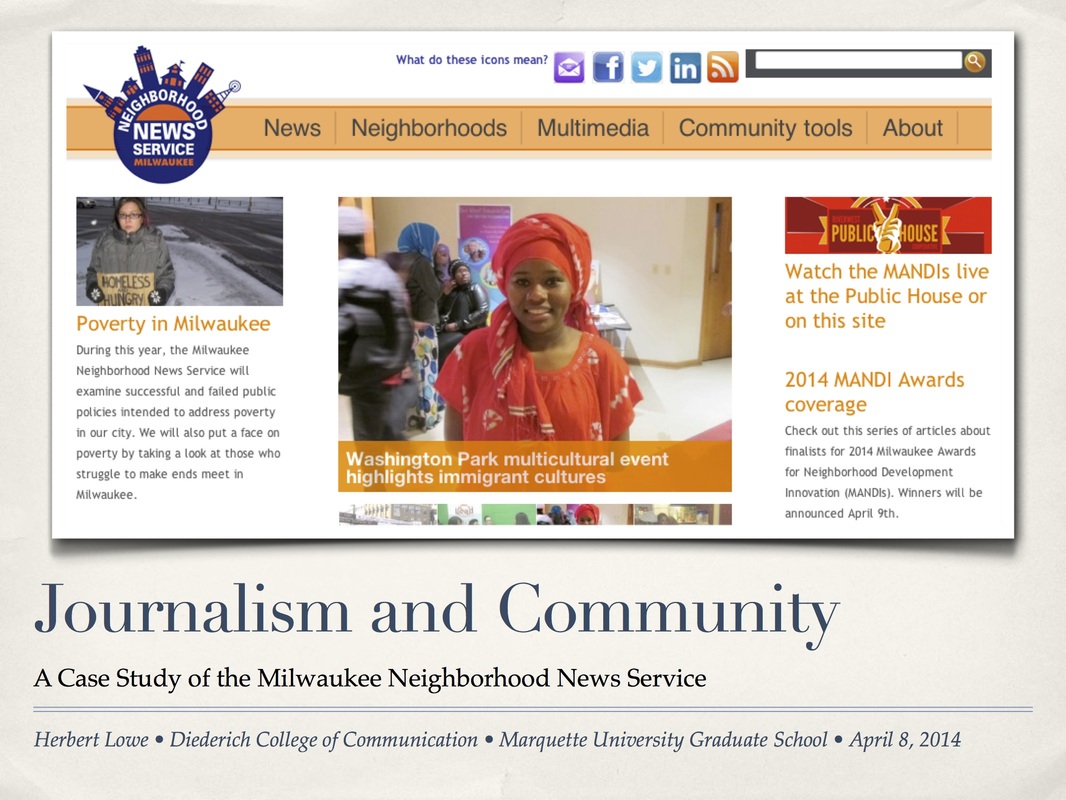
The Milwaukee Neighborhood News Service yesterday unveiled a special report focusing on eight nonprofit organizations that provide services to residents in local communities. Writing here with much pride that my Digital Journalism II students last fall created the 17 stories for the series, " How Service Agencies Work, From Inside and Out." Even more pleased that NNS Editor Sharon McGowan wishes to continue the series as she and I send those students enrolled in my latest JOUR 1550 class to profile another group of notable agencies and residents. McGowan met with JOUR 1550 last week to help me introduce the news service and to reveal this semester's community journalism assignments; they will be from among the 15 finalists for the 2012 MANDI (Milwaukee Awards for Neighborhood Development Innovation). "Anyone of these makes a good story, I think," she told the class. The editor and I then shared what we learned from our first experience working together. First and foremost, she said, more than a few students last semester seemed unprepared to craft and report a 400-word story. Next, too many factual errors – or, as McGowan put it, " stupid mistakes" related to names, dates, etc. "I really need much more attention to accuracy than I had from the last class," she said. "The factual errors just eat away at our (NNS) credibility. ... Here's how I want you to feel if that happens: I want you to feel sick." We're just getting started. "Students did not go into the interview sufficiently prepared," McGowan said, noting that agency leaders shared afterward that some had not spent enough time becoming familiar with their assignments. Source information was another problem. With any story, at any level of journalism, editors will likely have questions requiring reporters to reach back to those interviewed for more answers. For the JOUR 1550 assignments, however, many students did not get any contact information for the residents they spoke with. Not even a cell phone number, which seemed to particularly perplex McGowan. "We haven't come across anyone – in any neighborhood or income level – who doesn't have a cell phone or have access to one," she said. "We have to know how to reach them." Other concerns included knowing when to ask your editor for help and trusting when he or she says to cut bait. Case in point: one pair of students found an organization's leaders inaccessible for way too long. When McGowan proposed another group to feature, the pair dallied and ended up stressing during finals week to complete their work. (Oh yes, being published by NNS represented a significant part of each student's final grade.) For sure, these matters left me feeling charged, indicted and convicted as an instructor. Last semester was the first time I sent students into the community for assignments. In my three prior terms, I had only had assigned them to cover events on Marquette's campus, and in most cases I attended as well, so spotting factual errors was easy and sourcing wasn't a major problem, either. Of course, community work is much more instructional, it inspires students much more to do their best work and getting published by a professional news service provides invaluable exposure. On the other hand, because neither McGowan nor I live in Wisconsin, fact-checking and sourcing is crucial. All this to say the instructor and editor are better prepared to help JOUR 1550 and news service succeed. Most importantly, the students will begin their community work much earlier in the course. Instead of distinct multimedia packages on both a service provider and service recipient, they will produce just one package about their agency. Each package will offer multiple sources and longer text stories – 650 words long instead of 400. Also, they will submit drafts of their text stories long before the final deadline, so there's more time for editing and fact-checking. To be very clear, JOUR 1550 produced some exceptional work last semester for the news service, which is proudly promoting it as a series on its website. (Indeed, McGowan hired two of the students – Tessa Fox and Heather Ronaldson – as interns for this term.) Every news agency spends time learning how to make its product and journalists better, and what me and McGowan learned last term will surely better prepare my students for internships and their first jobs. If nothing else, there's satisfaction in having their work viewed by more than just their instructor. Here's what Kenya Evans, a part-time beat reporter for the news service, told the class last week after McGowan discussed how the local Fox News affiliate re-published one of her stories: "It feels good to know the stories are getting out there and that people are reading them." Based on these tweets below, my class is ready to get started:
The 2012 presidential election is well underway and students at colleges and universities across America are paying close attention. Everyone knows how much of an impact college students had on the 2008 campaign, particularly their enthusiastic support of Barack Obama and his quest to make history as a groundbreaking candidate promising hope and renewal for the country. It is and was no different at Marquette University. This semester, I'm proudly co-teaching a seminar course with my Diederich College of Communication colleague, James Scotton, that focuses on how the media report on political campaigns and local, state and national elections. Among the course objectives are gathering and curating social media to tell and present stories about campaigns and elections; developing a journalist's blog that offers fair and accurate commentary about media coverage, and analyzing how candidates use the media – and money – to shape their campaign messages. The course textbook is " The Obama Victory: How Media, Money and Message Shaped the 2008 Election." Published in 2010 by Oxford University Press, the book is authored by three scholars – Kate Kenski, Bruce Hardy, and Kathleen Jamieson – and addresses why Obama's election will go down as among the most pivotal in U.S. presidential history. As this is primarily a writing course, each student will write a weekly analysis of a book chapter and attempt to apply its findings and concepts to the national campaign underway four years later.Each of the 12 students this semester will also offer a 10-minute presentation about a hot-button election issue; the choices were abortion, civil rights, civil unions, criminal justice, the economy, education, the environment, family values, foreign affairs, health care, homeland security and immigration. They will also each present their findings about an assigned contested congressional, gubernatorial or mayoral campaign; live tweet from a couple of political events on campus, and blog at least once weekly about political coverage from an assigned news media website.Here's hoping the Republican presidential nomination isn't decided any time soon, as we'll have much deeper and more relevant discussion if Mitt Romney and Newt Gingrich continue to pummel one another with their political ads and the media get to demonstrate their strengths and weaknesses in the heat of battle. I'm slated to teach the course again in the fall, when the GOP nominee tries to keep Obama from being re-elected. Looking forward to it.
This is my third semester teaching Digital Journalism II in the Diederich College of Communication at Marquette University and so I hope to build on the success of my previous class in the fall. The course objectives remain the same: producing and promoting digital news stories using text, images and audio; understanding key industry trends, technologies and multimedia reporting techniques; working solo and or in teams to produce stories and packages for the Web, and using social media to build a following and "brand" as a digital journalist. Once again, the course textbook is the second edition of " Aim For The Heart: Write, Shoot, Report and Produce for TV and Multimedia." Published in 2011 by CQ Press, the book by Al Tompkins of the Poynter Institute is great for students because it stresses, among other things, finding memorable characters, writing inviting leads, using active verbs and objective adjectives, learning to listen during interviews and why pictures are so powerful. Each of the 10 students this semester will pursue a Digital Journalism Basics certificate from Poynter's News University, write a weekly blog post related to their assigned news media website; produce a Storify from each of four events on campus they will live tweet; produce two multimedia packages called "One at Marquette" and based on The New York Times' extraordinary " One in 8 Million" collection; and, with a partner, produce a multimedia package about a local nonprofit organization and assigned by the Milwaukee Neighborhood News Service. The students will share and promote their coursework on their respective digital portfolios created via Weebly.com. Those portfolios can be accessed collectively from the same webpage here. Check their progress often.
|