Herbert Lowe | Telling Stories One Tale At A Time
  • SHORT STORIES
  • MY STORY
  • CURRICULUM VITAE
  • #LOWECLASS
  • RESOURCES

Flash: Educators & Students Disagree

3/28/2012

1 Comment

 
Picture
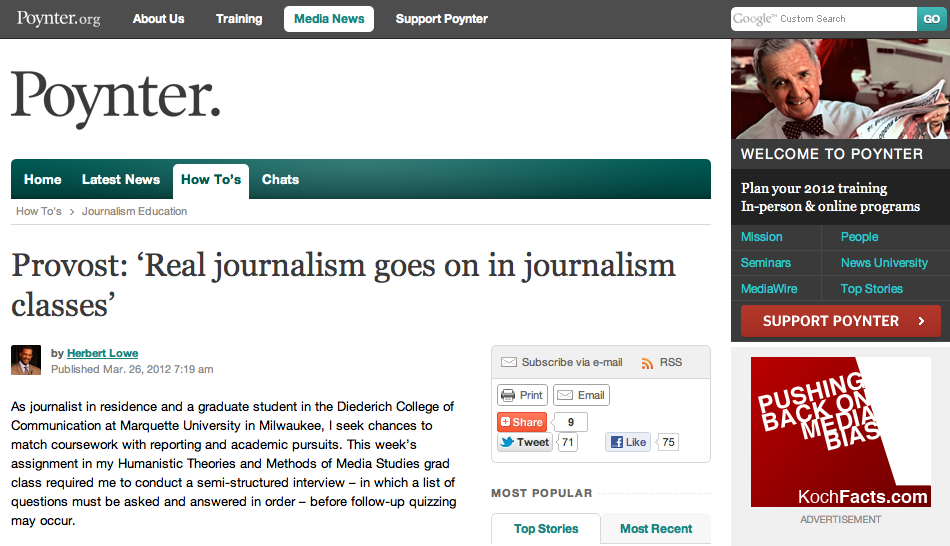
My last blog post focused on my Poynter.org article about students missing classes to cover March Madness. As promised, today we're exploring the topic again, based on another submission, a Q-and-A, for the same website.

The intro begins: "As a professional in residence and a graduate student ... I seek chances to match coursework with reporting and academic pursuits. This week’s assignment in my Humanistic Theories and Methods of Media Studies grad class required me to conduct a semi-structured interview – in which a list of questions must be asked and answered in order – before follow-up quizzing may occur. An hour before class last week, Poynter.org agreed that I should write about journalism educators dealing with students missing classes to cover March Madness. My reporting led me to an ideal person for the course assignment: Marquette Provost John J. Pauly, Ph.D."

After turning in the first story on Friday, I suggested to my Poynter editor that Pauly's view on the matter could interest many people. She agreed and skedded the Q-and-A to run on Monday. Well, there's been quite a bit of feedback. Based on a few tweets and not as many emails, journalism educators and others liked what the provost said. On the other hand, many Marquette students weren't too pleased with all that they read. Indeed, my Digital Journalism II class discussed both of the Poynter submissions for nearly an hour yesterday before I finally stopped them so they could work on their Milwaukee Neighborhood News Service projects.

Look Friday for another blog post about students covering sports journalism. Meanwhile, I'm looking forward to my professor's feedback about my critical assessment – my homework due in class last night – of my interview with the provost. Remains to be seen if and when I'll be sharing that any time soon.

Provost: ‘Real journalism goes on in journalism classes’ bit.ly/H6I92I via @poynter #highered #journalism

— AEJMC (@AEJMC) March 26, 2012

I dont' get it...is sports journalism not a real thing in the eyes of the Provost? bit.ly/GS0TlO Article by @herbertlowe

— Meg Pirics (@meggiemae18) March 26, 2012

@herbertlowe Some great advice for journalism teachers and students in that interview - thanks for sharing!

— Meg Wagner (@meg_wagner) March 26, 2012
1 Comment

'Cropaholic' Visits Digital Journalism Class

10/7/2011

3 Comments

 
Picture
"Most of the photos that people send us are from their phone," photojournalist Berford Gammon tells Marquette journalism students.
Berford Gammon admits he is a "cropaholic." So when the Milwaukee Journal Sentinel's photography director visited my Digital Journalism II class yesterday, eliminating wasted space was a constant theme in his critique of the students' first photojournalism assignment of the semester. So was avoiding redundancy, ensuring story clarity and details, knowing when to use your flash and shooting far more photos than one might think necessary.

Gammon – a native of Columbus, Ohio, who graduated from Ohio State University – and I worked together several years ago at The Philadelphia Inquirer. Using Journal Sentinel photos from the Milwaukee Brewers' playoff run and a feature story about midwives, he also talked about meeting deadlines, maximizing internships, managing photographers, writing captions and working with reluctant or difficult story subjects so you get the best photos.

The photography director also advised the students to stay relevant in their campus or professional organization. Take newsrooms, for example: "You've got to have an opinion on something in journalism. If you don't have an opinion, say, 'Let me have a look at it and I'll get back to you.'" Communications skills are also important. "I always tell my photographers, 'If you can explain your photo to me, and why it's important, then we'll get it in the paper."

While discussing photos shown on the classroom wall, Gammon often called on the class to identify the correct photographic element from among the 14 cited in the NewsU "Language of the Image" module. That so many raised their hands for him to critique their work surprised him. "I love this class!" he said. Based on their tweets afterward, the class appreciated him, too. "Teaching us all how to be real photojournalists," Erin Caughey tweeted.

3 Comments

Joining With NewsU to Help My Students

9/8/2011

3 Comments

 
Picture
The Poynter Institute's e-learning project, News University, was among the first places I turned to before starting my first semester as a journalism educator in January 2010. (I found great syllabi to pull ideas from at NewsU's syllabus exchange and recommend it to all beginning journalism educators.) Recently, I called Vicki Krueger at NewsU to learn more about how my two digital journalism courses could best employ its offerings this semester. That conversation and subsequent ones with Howard Finberg at NewsU and Diederich College Dean Lori Bergen and journalism department chairwoman Karen Slattery have in a two-week span led to something phenomenal.

Here's what I wrote in my syllabi for my Digital Journalism I and Digital Journalism II courses: "As part of an experimental effort between the Diederich College of Communication and the Poynter Institute’s News University, students in this course will have the chance to earn, along with a grade, a certificate from the nation’s premiere journalism think tank. Poynter says its NewsU certificates help the instructor supplement other teaching material and evaluate each student’s understanding of essential journalism skills and best practices. The custom certificate created by the college and Poynter consists of seven online modules. To earn a certificate, each student must pass the assessments for each of those modules. Poynter describes the assessments as rigorous and designed to test comprehension and not memorization. Earning this certificate will be of immediate value to each student, as it will look great on a LinkedIn profile, especially when time to apply for internships and or that first job after graduation."

My students know a good thing when they see it and are excited about the certificate opportunity. In each class, the initiative is required and accounts for 15 percent of the final grade. While each course will have seven modules formally accessed, I'll also use several other NewsU modules as interactive learning guides during class time. Essentially, the modules serve as textbooks; I lead the class discussion same as with any other online resource.

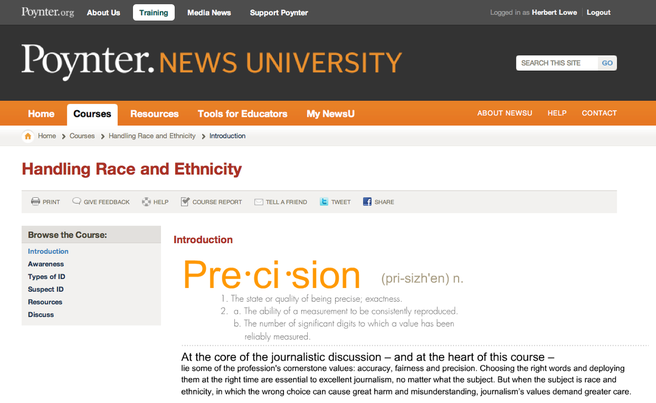
On Tuesday, both classes engaged in our first module, "Handling Race and Ethnicity." We looked at how we view these critical matters, how and when they should appear in news stories, and describing suspect identification and the way people look. I found it interesting that so many of my students consider themselves German; I wouldn't have suspected the number would be so high just by looking at them – that's part of the lesson, for whomever engages the module, no matter their level of journalism or life experience. What did not surprise me is how seriously my students took to what the module offered, as they definitely seem to care about diversity and portraying people accurately.

I hope to write about this certificate experience in this blog through the semester. Another lesson: don't have the students look at a module on their classroom computers while I'm doing the same from the projector. At least a couple of them will move ahead of the lesson and know the correct answer before I ask for it. Students!

3 Comments
Forward>>

    Welcome

    My journalism DNA remains strong as I learn and teach new ways to tell and present stories, especially via digital and social media. This blog is where I share what happens in my classroom and my life and, from time to time, offer my views on current events. I appreciate your feedback – either as comments herein or in an email to herbert.lowe [at] marquette [dot] edu.

    Tweets by @herbertlowe

    Archives

    January 2015
    December 2014
    October 2014
    September 2014
    August 2014
    July 2014
    June 2014
    May 2014
    April 2014
    January 2014
    December 2013
    June 2013
    May 2013
    April 2013
    March 2013
    February 2013
    January 2013
    December 2012
    November 2012
    October 2012
    September 2012
    August 2012
    July 2012
    June 2012
    May 2012
    April 2012
    March 2012
    February 2012
    January 2012
    December 2011
    November 2011
    October 2011
    September 2011
    August 2011
    July 2011
    June 2011
    May 2011
    December 2010
    November 2010
    October 2010
    September 2010

    Categories

    All
    Branding
    Digital Divide
    Digital Storytelling
    Emerging Media
    Graduate School
    Journalism
    Journalism Education
    Journalism Education
    Live Tweeting
    Marquette
    NABJ
    NewsU
    NNS
    Poynter
    Sports
    Storify

    RSS Feed

Powered by Create your own unique website with customizable templates.